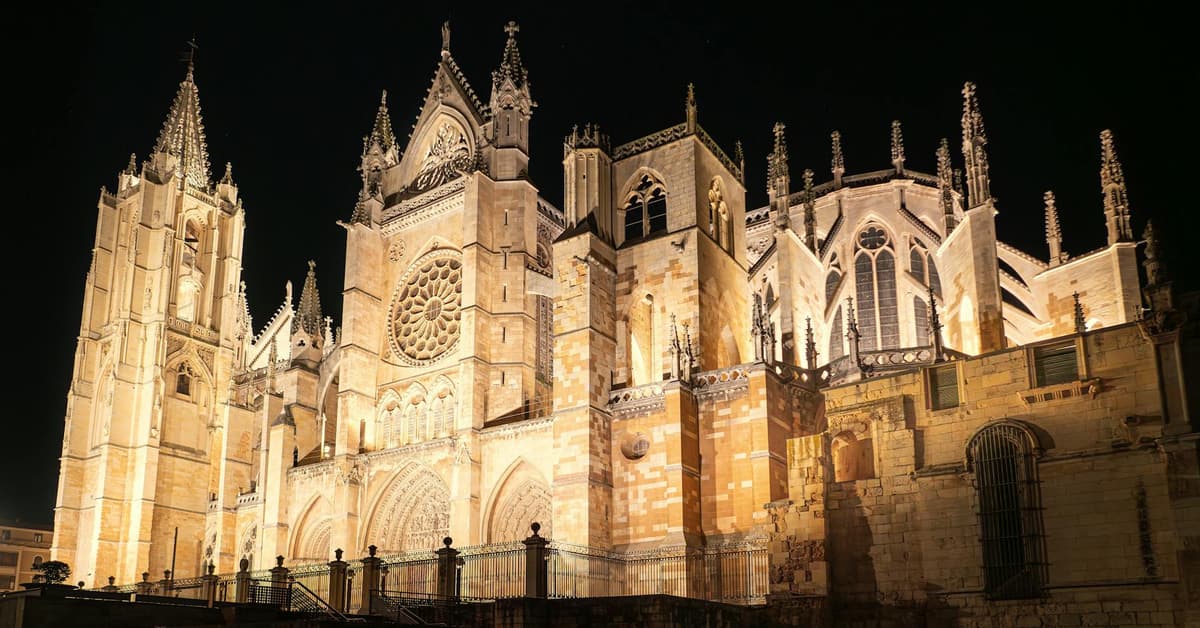
Leon is the capital of the province of Leon, in the northwest of Spain. It was founded as a Roman military camp in the 1st century BCE for the Legio VI Victrix and later occupied by the Legio VII Gemina, the Twin Seventh Legion. The name Leon comes directly from the Latin legio: this was always a city of soldiers. Roman walls, in much-reworked form, still trace the boundary of the old city centre. The Camino Frances enters Leon through the eastern suburbs and runs through the heart of the medieval quarter.
After the Roman period, Leon rose to become the capital of the medieval Kingdom of Leon, a Christian kingdom that played a leading role in the Reconquista against Moorish rule. The kingdom was at its height in the 10th and 11th centuries, and the city's principal monuments date from this period and the centuries that followed. The Real Colegiata de San Isidoro, built in the 11th century by King Ferdinand I and Queen Sancha, houses the Pantheon of Kings, a Romanesque royal mausoleum whose ceiling frescoes have been called the Sistine Chapel of Romanesque art. The cathedral, begun in the 13th century, is a French Gothic building nicknamed the Pulchra Leonina, the Beautiful Leonese, famous for around 1,800 square metres of stained glass that floods the interior with coloured light at almost any hour. The monastery of San Marcos, originally a pilgrim hospital founded by Queen Sancha in the 12th century, was rebuilt in the 16th century in elaborate Plateresque style and now operates as a luxury parador hotel. Casa Botines, by Antoni Gaudi, sits in the Plaza de San Marcelo and was an early commission for the Catalan architect outside Catalonia; it now functions as a museum.
Leon has the full range of city services. Pilgrims will find the Albergue Municipal de Leon and the Albergue de las Carbajalas, run by Benedictine sisters, both close to the cathedral, alongside private albergues, pensions, hotels, and hostels at every price point. The city has restaurants, cafes, bars, supermarkets, pharmacies, ATMs, hospitals, medical care, and a railway and bus station with connections to Madrid, the Galicia coast, and northern Spain.
Leon is the only city between Burgos and Santiago that earns a full rest day. The Barrio Humedo, the tangle of streets south of the cathedral, is the city's tapas district and where the city comes alive in the evening.