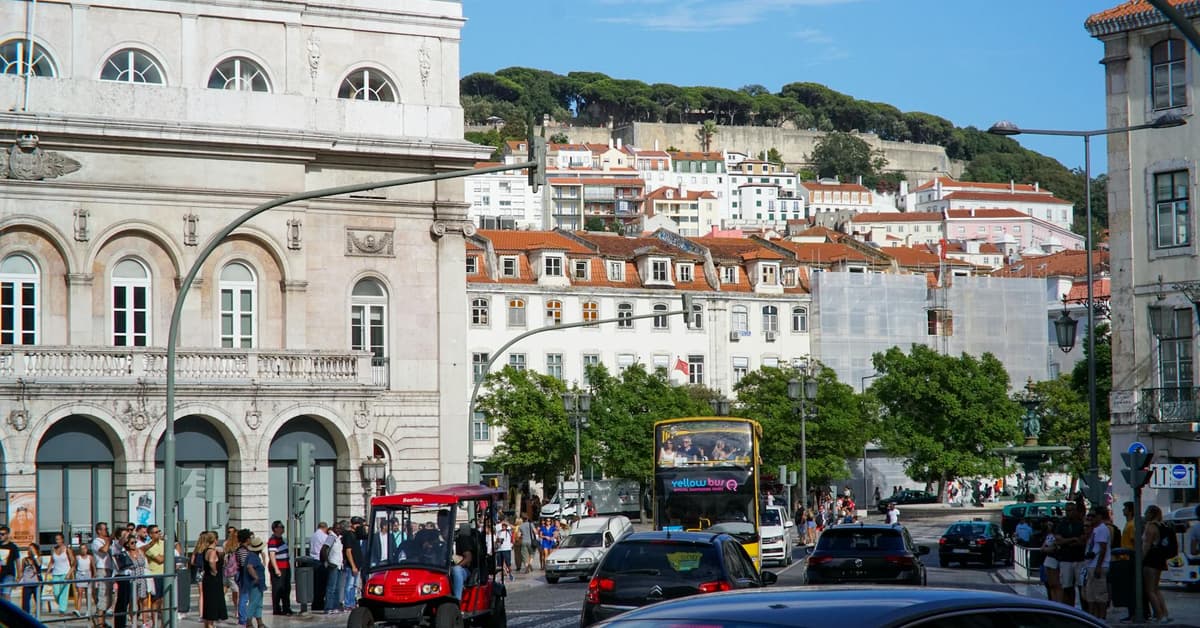
The origins of this city's name have sparked debate for centuries. Legend suggests Ulysses founded the settlement during his wandering, calling it Olissipo. Archaeologists, however, trace the roots to the Phoenicians, who arrived around 1200 BC and likely named the estuary Allis Ubbo, meaning safe harbor. Under Roman rule, it became Felicitas Julia Olissipo. When the Moors took the Iberian Peninsula in the eighth century, the name softened into al-Ushbunah, which eventually shifted into the modern Portuguese Lisboa.
Pre-dating Rome by centuries, the city climbs from the Tagus River across steep hills, a demanding geography that dictated its expansion. In 1147, Portugal's first king, Afonso Henriques, captured the settlement from the Moors with the help of passing Crusaders. By the fifteenth and sixteenth centuries, the city had become the center of a vast maritime empire. Caravels departed from the riverfront to chart routes to India, Africa, and Brazil, returning with spices and gold that funded extravagant Manueline architecture, characterized by maritime motifs carved heavily into limestone.
The defining moment of the modern era occurred on the morning of November 1, 1755. A massive earthquake struck on All Saints Day, followed by a towering tsunami that rushed up the Tagus and fires that burned for days. Much of the medieval center was obliterated. Under the pragmatic direction of the Marquis of Pombal, the ruined downtown was cleared and replaced with the Baixa Pombalina. This lower district features a strict grid layout and some of the world's earliest seismically engineered buildings. They were constructed with an internal wooden lattice known as a Pombaline cage, designed to flex rather than snap during tremors.
When walking through the Baixa today, visitors are treading over layers of buried history. Beneath the streets lie the remains of a Roman fish-salting complex where garum, a pungent fermented fish sauce, was mass-produced for the empire. Above ground, the consequences of the 1755 earthquake remain visible by design. At the Carmo Convent in the Chiado district, the Gothic arches of the church still stand against the sky, deliberately left roofless as a permanent memorial to the disaster.
To experience the winding urban layout that existed before the earthquake, visitors should walk the labyrinthine alleys of the Alfama. Because it sits on dense bedrock, this ancient Moorish district largely survived the tremors. Its narrow, confusing street plan was originally intended to thwart invaders and break the fierce winds coming off the river. High above the Alfama sits the Castelo de São Jorge. While much of the visible stone was heavily restored in the 1940s, the hilltop itself has held fortifications since the Iron Age.
Navigating the steep inclines requires stamina, but the effort is rewarded by the miradouros, or public viewpoints. The Miradouro de Santa Luzia offers sweeping sights over the terracotta roofs of the Alfama toward the river, framed by bougainvillea and classic blue and white tile panels. Higher still is the Miradouro da Senhora do Monte, which provides an expansive orientation of the topography and the castle.
While exploring, look closely at the building facades covered in azulejos, the glazed ceramic tiles that define the local aesthetic. Introduced by the Moors and embraced over the centuries, these tiles are not merely decorative. They protect the masonry from damp coastal air and help reflect the fierce summer sun. Underfoot, the sidewalks are paved in calçada portuguesa, intricate mosaics of white limestone and black basalt. The undulating wave pattern in Rossio Square was laid in the nineteenth century and inspired similar pavements as far away as Rio de Janeiro. A practical warning for walkers: because the limestone is polished by millions of footsteps, the hills become remarkably slick, especially when wet or covered in dry summer dust. Footwear with strong grip is essential.
For a quieter moment of historical reflection, seek out the Largo do Carmo. It was in this small, shaded square on April 25, 1974, that forces of the Armed Forces Movement surrounded the military police headquarters. This action led to the surrender of the prime minister and the end of Europe's longest-surviving authoritarian regime. The bloodless coup became known as the Carnation Revolution when civilians placed red carnations in the muzzles of the soldiers' rifles.
The most rewarding way to understand this place is to start early in the day, before the midday heat, and simply observe the shifting light. The wide river acts as a massive mirror, bouncing a uniquely clear illumination onto the pastel buildings, a phenomenon that has fascinated painters for generations. Pay attention to the tight corners where old tram lines brush past centuries-old masonry, and look for the municipal coat of arms on streetlamps. It depicts a ship carrying the remains of Saint Vincent, guided by two ravens. According to local lore, direct descendants of those legendary ravens lived in the castle grounds well into the twentieth century.