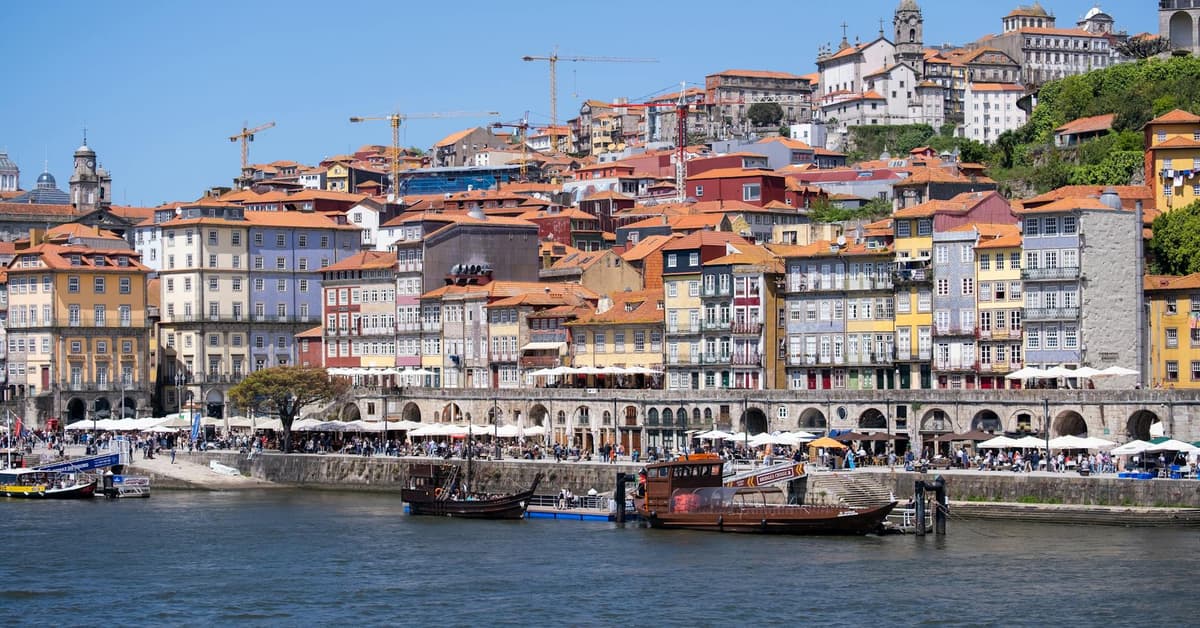
Famous for its fortified wine and the Dom Luís I Bridge, Porto sits where the Douro River meets the Atlantic. This UNESCO-listed city is the traditional starting point for pilgrims walking the Portuguese Way to Santiago de Compostela.
Porto is one of the few cities in the world that gave its name to an entire country. When the Romans arrived at the mouth of the Douro River, they found a settlement they called Portus Cale. Over centuries, that name evolved into Portucale and eventually became Portugal. The meaning of "Cale" remains a subject of debate among historians, with some suggesting a Celtic root meaning "port" and others pointing to a local pagan goddess. Today, the city rises steeply from the northern bank of the Douro as a dense stacking of granite buildings, narrow alleys, and monumental churches.
The physical steepness of Porto is mirrored by its fierce historical independence. In 1415, an expedition left the city to conquer the North African port of Ceuta. According to local historical tradition, the citizens of Porto surrendered all their prime cuts of meat to provision the departing fleet. Left with only the offal, they invented a dense, hearty stew made of tripe and white beans. To this day, people from Porto are known throughout Portugal as "Tripeiros" or tripe eaters. The man who orchestrated that fleet was Prince Henry the Navigator, who was born in the city in 1394.
That resilient streak appeared again centuries later. During the Peninsular War in 1809, Napoleon's troops invaded the city. Thousands of fleeing locals tried to cross the Douro on a makeshift bridge of tied boats, which collapsed under the weight. This tragedy is remembered today by a bronze relief plaque near the riverfront called the Alminhas da Ponte, where locals still leave candles for those who drowned. A few decades later, during the Portuguese Civil War in 1832, Porto withstood a brutal year-long siege by absolutist forces. The city held firm for the liberal cause, earning it the official title "A Invicta," the unvanquished city.
For those walking north, Porto is the traditional starting point of the Portuguese Camino. The journey begins at the Sé, the twelfth-century cathedral that sits on the highest hill like a fortified castle. Its defensive crenellations hint at an era when the church doubled as a military stronghold. Pilgrims traditionally collect their first credential stamp inside. The cathedral courtyard offers a sweeping view over the labyrinthine streets plunging down to the river. In the center of this square stands a stone pillory. While it looks purely medieval, it was actually erected in the 1940s during a controversial period of urban restoration. The genuine history lies in the cathedral walls and the quiet gothic cloister adorned with blue and white azulejo tiles.
Just below the cathedral lies the São Bento railway station. Built on the ruins of a Benedictine monastery, its walls are covered with twenty thousand tin-glazed ceramic tiles painted by Jorge Colaço in 1916. Visitors often walk quickly through the atrium, but it is worth stopping to read the walls like a history book. Look specifically for the panel depicting the meeting of the knight Egas Moniz and Alfonso VII of León in the twelfth century, a foundational moment in Portuguese independence.
Closer to the river, the Dom Luís I Bridge dominates the skyline. It is often mistakenly attributed to Gustave Eiffel. Eiffel did design the nearby Maria Pia railway bridge, but the striking double-deck Dom Luís I bridge was the work of his disciple, Théophile Seyrig.
Exploring Porto requires strong legs and a willingness to get lost in the steep, winding stairways connecting the upper city to the riverside Ribeira district. The Escadas do Barredo is one such staircase, taking you past weathered stone facades and clotheslines that have changed little in centuries. For a striking visual anchor, look up at the towering Clérigos Tower designed by Italian architect Nicolau Nasoni in the eighteenth century, which historically guided ships navigating the treacherous river mouth.
If you plan to cross the upper deck of the Dom Luís I bridge to the neighboring city of Vila Nova de Gaia, go early in the morning when the mist is still rising off the Douro to avoid heavy crowds. Keep a close watch for the silent metro trains that share the pedestrian space. Looking back at Porto from the Gaia side provides the clearest sense of the city as it grew, climbing stubbornly upward from the docks to the cathedral, built stone by stone by people who never gave up their ground.
Every kind of bed in one place: online booking, direct-contact albergues, walk-ins and donativos. Live prices for your night.
The Camino through town, with prices where the beds are. Amber is the route; each pin is a place to stay.
How to reach your starting point from major cities and airports.
Porto Francisco Sá Carneiro Airport is 11 km northwest of the city centre. The Metro Violet Line runs directly from the airport to the centre (Trindade or São Bento stations) in around 30 minutes. Taxis take approximately 20 minutes.
Trains from Lisbon arrive at Porto Campanhã station (around 3 hours by fast train). From Campanhã, a short connecting train takes you to São Bento station in the heart of the old town, steps from the Sé Cathedral where the Camino begins.
Rede Expressos and FlixBus connect Porto from Lisbon (3.5 hours), Coimbra, Braga, and Spanish cities. The main bus station is at Campo 24 de Agosto, a short walk or metro ride from the centre.
Parking in the old town is extremely limited and expensive. There are park-and-ride options on the outskirts connected by metro. You will not need a car once you begin walking.
Your checklist for arrival day in Porto.
Visit the Sé Cathedral (Porto Cathedral) in the historic centre to purchase your credential. It costs around €2. The Sé is the official starting point of the Camino Português from Porto, shared by both the Central and Coastal routes. Your credential is required for staying in albergues and receiving your Compostela in Santiago.
Our Koala Picks first, then donativos, albergues and hostels, hotels, and everything else. Within each group the best-reviewed places lead.
Loading places to stay…
Everything you need to know for your time in Porto.
A new Porto Pilgrim Office (Oficina do Peregrino do Porto) officially opened on April 11, 2026, located at Rua da Pena Ventosa 38, near the Porto Cathedral.
Multibanco ATMs are found throughout the Ribeira and Baixa districts. Several banks are clustered around Avenida dos Aliados, a short walk from the Sé.
Farmácias are common throughout Porto's old town. Look for the green cross. There are several on Rua de Santa Catarina, Porto's main shopping street.
