Town

Portomarín

354m
42.8061°N, 7.6170°W

Coordinates

42.8061°N, 7.6170°W

Elevation

354m

Accommodation

Available

Services Available

Accommodation
Restaurant
Cafe
Grocery
Pharmacy
ATM
Train
Post Office
Airport
Bus
Pilgrim Office
Clinic
Water
Tobacconist

About Portomarín

Portomarin sits in the province of Lugo, in Galicia, on the western bank of the Belesar reservoir, the long artificial lake created when the river Mino was dammed in 1962. The town is the traditional end of stage 29 for pilgrims coming from Sarria. The Camino approaches Portomarin across the long modern bridge over the reservoir and climbs a steep staircase into the new town built above the high-water line.

Portomarin has been a Camino stop since the Middle Ages. The original medieval town stood on the banks of the Mino at the foot of the hill, around a Roman bridge that was rebuilt for pilgrims by King Pedro I of Castile in the 14th century. The town had two principal parishes, two pilgrim hospitals, and a fortified church built by the Knights of Saint John of Jerusalem in the 12th century. In 1962, the Spanish government built the Belesar dam downstream, creating a hydroelectric reservoir that flooded the entire valley. Before the waters rose, the most important medieval buildings were dismantled stone by stone, with each block numbered and catalogued, and reassembled on the high ground above. The fortress-church of San Xoan (also called San Nicolas), a 12th-century Romanesque-Gothic Templar-Hospitaller church, was the most significant building moved, and now dominates the new central plaza of the rebuilt town. The smaller Iglesia de San Pedro was also rebuilt. The numbered stones on the church walls are still visible at close range.

Portomarin has the full range of services. There are albergues including the municipal Albergue de Peregrinos and private albergues, hotels, restaurants, cafes, bars, supermarkets, a pharmacy, and ATMs. The town has bus connections to Lugo and Sarria. Portomarin is also known for Galician aguardiente, the regional grape-spirit distilled here for centuries.

When the reservoir water is low enough (usually late summer in dry years), parts of the old medieval town become visible at the foot of the climb up to the new town. The old Roman-medieval bridge piers, sections of foundation walls, and the cobbled streets sometimes emerge from the receding water. It is a haunting sight unlike anything else on the route.

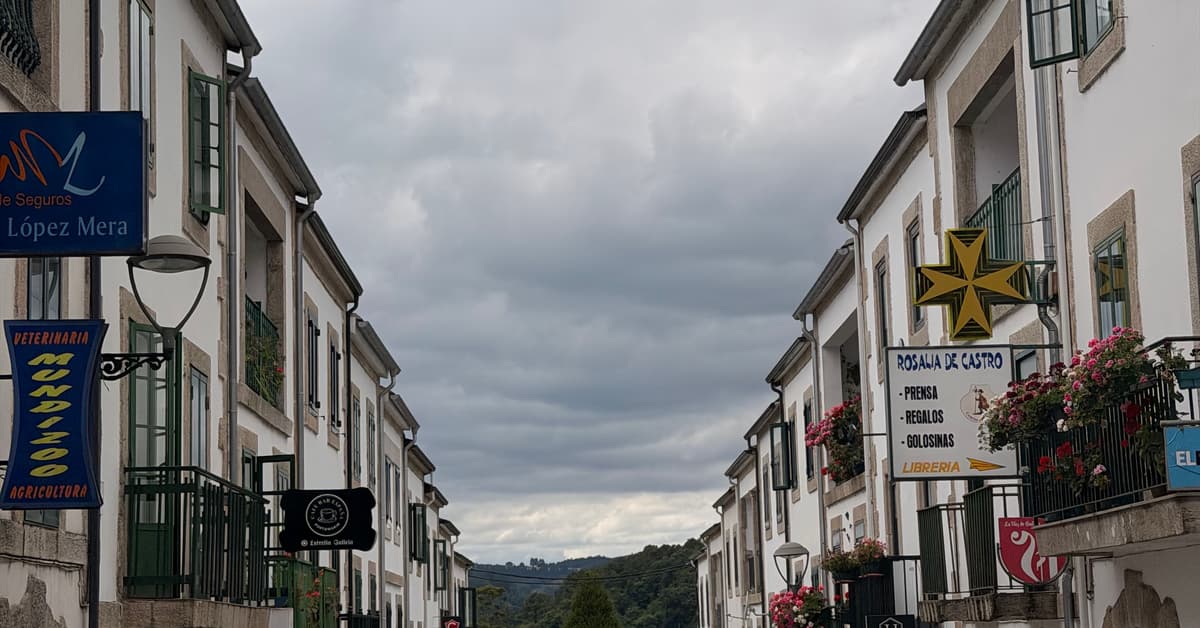
Explore Portomarín

Things to Do in Portomarín

History

The Town That Moved

The original Portomarin lies beneath the waters of the Belesar reservoir, which flooded the old town in the 1960s. Before the flooding, the most important buildings were dismantled stone by stone and rebuilt on higher ground. The Iglesia de San Nicolas (also called San Juan), a fortified Romanesque church, was painstakingly moved to its current position overlooking the reservoir. When water levels drop in summer, you can sometimes see the remains of the old town and the original bridge beneath t

Sightseeing

Visit the Iglesia de San Nicolas

A 12th-century fortified church that looks more like a castle than a place of worship. The thick walls, small windows, and crenellated roofline were designed for defence as much as prayer. Inside, the carved doorway and the rose window are impressive. This building was moved from its original location below the reservoir and rebuilt in the main square. Stand in front of it and consider the effort required to save it from the rising water.

Camino Moment

Cross the Long Bridge

The approach to Portomarin involves a steep descent to the Rio Mino, the most important river in Galicia, followed by a long walk across a modern bridge over the reservoir. On a clear day, the blue water stretches in both directions and the town sits on the hillside above. The climb up to the town after the bridge is steep and serves as a reminder that Galicia, despite being the final stretch, is not flat.

Food & Drink

Try the Aguardiente

Galicia is known for its aguardiente, a strong grape spirit. In Portomarin and the surrounding area, you will also see queimada, a traditional Galician drink made by setting aguardiente alight with sugar, lemon peel, and coffee beans while reciting an incantation to ward off evil spirits. Some restaurants and albergues perform the queimada ceremony for groups of pilgrims. It is theatrical, fun, and the drink is surprisingly smooth.

Relaxation

Rest in the Main Square

The Plaza Conde de Fenosa is the heart of the rebuilt town. The Iglesia de San Nicolas dominates one side, and arcaded buildings with bars and restaurants line the others. Pull up a chair at one of the terraces, order a coffee or a glass of wine, and people-watch. The mix of long-distance pilgrims and fresh-faced Sarria starters makes for good observation.

Accommodation in Portomarín

Where You Are on the Camino

You are here

Portomarín

93 km to Santiago de Compostela

Part of

SarriàPortomarín(Previous Stage)
View stage
PortomarínPalas de Rei(Next Stage)
View stage