Village

O Cebreiro

1288m
42.7078°N, 7.0438°W

Coordinates

42.7078°N, 7.0438°W

Elevation

1288m

Accommodation

Available

Services Available

Accommodation
Restaurant
Cafe
Grocery
Pharmacy
ATM
Train
Post Office
Airport
Bus
Pilgrim Office
Clinic
Water
Tobacconist

About O Cebreiro

O Cebreiro sits in the province of Lugo at 1,300 metres altitude on the mountain pass that marks the entry into Galicia from the east. It is the first Galician village on the Camino Frances and a historically defining stop on the route. The Camino climbs to the village from Laguna de Castilla and crosses through the heart of O Cebreiro before beginning the long descent into Galicia.

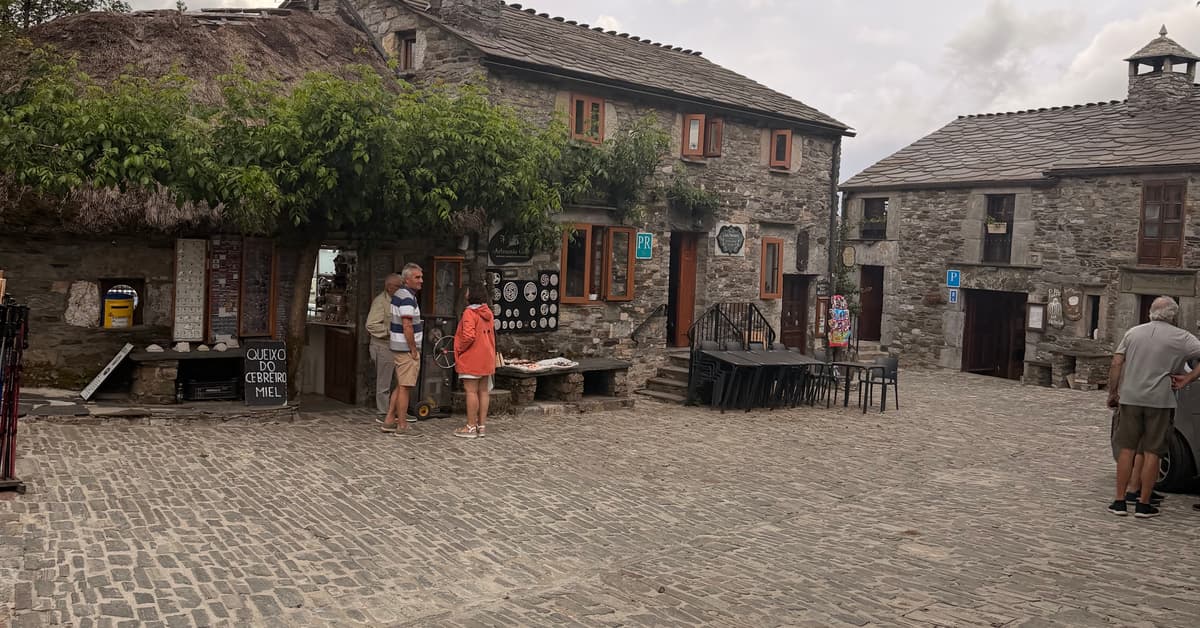
O Cebreiro preserves several pallozas, pre-Roman Celtic circular stone houses with thatched roofs, an architectural form once common across the Celtic mountain regions of northwest Iberia and the British Isles, but now surviving only in a handful of places. The pallozas were lived in until the 1960s and several have been preserved as a small ethnographic museum. The village also has the Iglesia de Santa Maria la Real, a pre-Romanesque stone church dating back to the 9th century, predating most churches on the Camino by several hundred years. The church is associated with a famous medieval Camino miracle. In 1300, according to tradition, a sceptical priest celebrating Mass during a snowstorm watched the consecrated host turn to flesh and the wine to actual blood in the cup before a single pilgrim who had braved the storm to attend. The chalice from this miracle is held in the church and is sometimes called the Spanish Holy Grail.

The other major figure associated with O Cebreiro is Don Elias Valina Sampedro, the parish priest of the village in the 1970s and 80s, who is credited with the practical revival of the modern Camino. Valina mapped the entire Camino Frances on foot in the 1980s and used yellow paint (left over from highway work) to mark the route with arrows. The yellow arrow system spread along the entire Camino and is now the standard route marker used worldwide. Don Elias died in 1989 and is buried at the church in O Cebreiro. The tomb is a quiet pilgrim site, and many walkers leave a small offering or a yellow object as thanks.

O Cebreiro has reasonable services for a village its size. There are albergues including the large municipal albergue, hotels, restaurants, bars, and a small shop. There is no pharmacy or ATM. The village fills with pilgrims on most evenings of the main walking season, and beds book up early.

Explore O Cebreiro

Things to Do in O Cebreiro

Sightseeing

Visit the Pallozas

O Cebreiro is famous for its pallozas, pre-Roman Celtic round houses with thick stone walls and thatched roofs of rye straw. Several have been preserved and restored. The Palloza de Xan Lopez has been converted into an ethnographic museum where you can see the interior layout, the central hearth (lareira), the area where livestock was kept, and the furniture and tools of daily mountain life. These structures were continuously inhabited until the mid-20th century.

Sightseeing

See the Church of Santa Maria la Real

The oldest complete church on the Camino de Santiago, dating from the 9th century. Built in pre-Romanesque style, this is where the famous Eucharistic miracle is said to have occurred in the 14th century. During a snowstorm, a priest celebrating mass with no congregation was visited by a single villager. At that moment, the bread and wine are said to have become the actual body and blood of Christ. The chalice and paten from the miracle were adopted into the Galician coat of arms.

Camino Moment

Welcome to Galicia

O Cebreiro marks the border between Castilla y Leon and Galicia, the final region of the Camino. The landscape transforms dramatically. The brown plains of the Meseta are gone, replaced by green mountains, chestnut forests, and misty valleys. The air smells different. The architecture changes to slate and granite. The language on the signs shifts to Galego. For many pilgrims, arriving in O Cebreiro feels like the beginning of the end.

Food & Drink

Try Queso de Cebreiro

A distinctive local cheese shaped like a chef's hat (or a mushroom), made from cow's milk in the mountain villages around O Cebreiro. It has a creamy, slightly acidic flavour and a soft interior. Order it at any bar in the village, either fresh or grilled. It is unlike any cheese you will have eaten on the Camino so far and makes an excellent trail snack for the stages ahead.

Sightseeing

See the Pilgrim Statue at Alto de San Roque

A couple of kilometres beyond O Cebreiro on the way to Triacastela, at the heights of San Roque (1,270 metres), stands a bronze statue of a pilgrim leaning into the wind, scanning the valley below. On a clear day, the views from here are among the most breathtaking on the entire Camino. On a misty day, the statue appears and disappears like a ghost. Either way, it is an unforgettable image.

Accommodation in O Cebreiro

Where You Are on the Camino

Previous town

La Laguna de Castilla

2 km back

Next town

Liñares

3 km ahead

You are here

O Cebreiro

154 km to Santiago de Compostela

Part of

Villafranca del BierzoO Cebreiro(Previous Stage)
View stage
O CebreiroTriacastela(Next Stage)
View stage