The Plaza de la Leña was known from the Late Middle Ages as Eirado or Eiradiño in the 15th century . This square housed a market where inhabitants of neighboring villages came to sell firewood that would fuel the kitchens and houses of the walled town . Here, muleteers from the surrounding area gathered with their carts full of firewood, and peasant women with their bundles of twigs and baskets of pinecones. [ 3 ]
This market took place every day, with Monday being the most important day, as it was the day carts loaded with oak firewood arrived in the city , which the bakers greatly appreciated for fueling their ovens. The square became known as Eirado in 1635. [ 4 ] [ 5 ]
The square was redesigned and enlarged in the 18th century , when the two large manor houses on the east side, the Pazo de Castro Monteagudo and the Pazo de García Flórez , were built. In 1854 it acquired the name Eiradiño da Leña, when the firewood sellers who had previously been located behind the San Francisco convent moved to the square . [ 6 ] In 1931 it was called Plaza de Jaime Vera, but it regained its official name of Eiradiño da Leña in 1950. [ 5 ]
The 15th- century granite Gothic cross [ 7 ] located in the center of the square was placed there around 1941 at Castelao 's request . The cross, which was broken into several pieces, was temporarily restored by Castelao for his work As cruces de pedra na Galiza . [ 8 ]
In 1969, the Plaza de la Leña was one of the locations used in the filming of the movie Esa mujer , starring Sara Montiel . [ 9 ]
The square regained its former pedestrian use on April 7, 1990. [ 10 ] In 1998, several scenes from José Luis Cuerda 's film Butterfly's Tongue were filmed in the square . [ 11 ] In 2025, it was a prime location for the filming of the movie *Romería * [ 12 ] and the series * Las hijas de la criada *. [ 13 ] [ 14 ]
Description
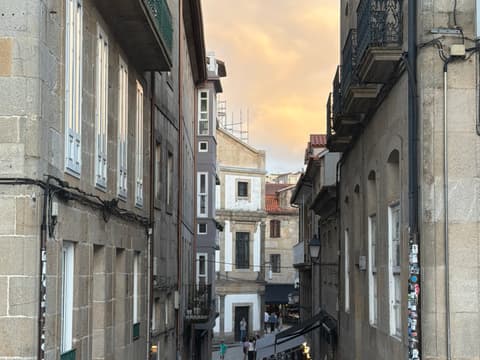
It is one of the smallest squares in the historic center and the most picturesque medieval square in the region. It represents the typical medieval square of Galicia. Prominent artists have created countless drawings, engravings, watercolors, and oil paintings of it, and it has been a source of inspiration for writers and poets such as Cándido Viñas Calvo .
The square has an irregular rectangular shape. In the center of the square stands a 16th- century granite cross from Caldas de Reyes . The cross consists of a three-tiered stepped platform, a cubic base with gently chamfered edges, and a vertical support formed by a cylindrical shaft without a base, topped with a cubic capital and adorned with vertical details. At the top is a cross, on the main side of which is a figure of Christ crucified, while on the reverse appears the Virgin standing, with the Child Jesus in her arms. [ 8 ]
Night view
Pasantería and Figueroa streets converge at the square . On the east side of the square stand the García Flórez and Castro Monteagudo manor houses , 18th- century Baroque buildings (now part of the Pontevedra Museum ), connected by a kind of bridge with a granite arch. [ 15 ] Along the north, south, and west sides are traditional Galician houses with arcades and wooden galleries on the west and south sides, and balconies decorated with flowers on the north and south sides. The upper floors were once used as living quarters. The houses vary in height from one to two stories.