- Home
- Santiago de Compostela
Santiago de Compostela
Coordinates
42.8820°N, 8.5468°W
Elevation
244m
Accommodation
Available
Services Available
About Santiago de Compostela
Santiago de Compostela is the end of the road. Every Camino route, from every direction, converges on this city and its cathedral. For over twelve hundred years, pilgrims have been walking here to visit the tomb of Saint James the Great. Alongside Rome and Jerusalem, Santiago is one of the three holiest pilgrimage destinations in Christianity.
The story begins around 813 AD, when a hermit named Pelayo saw strange lights flickering above a forest near Libredon. Bishop Teodomiro of Iria Flavia investigated and discovered an ancient tomb containing three bodies, declared to be Saint James and two of his disciples. King Alfonso II of Asturias travelled from Oviedo to visit the tomb, becoming the first pilgrim to Santiago. That journey is now the Camino Primitivo, the Original Way. Alfonso ordered a chapel built over the tomb. Larger churches followed, and in 997 the Moorish commander Almanzor sacked the city and destroyed the church but left the tomb untouched. Construction of the current cathedral began in 1075 and was consecrated in 1211.
The cathedral is a palimpsest of a thousand years of architecture. The famous Baroque facade on the Praza do Obradoiro was completed in 1740. Behind it stands the Portico de la Gloria, Master Mateo's extraordinary Romanesque sculptural ensemble carved in 1188 and recently restored to reveal traces of its original colour. Inside, pilgrims descend to the crypt beneath the high altar to see the silver reliquary holding the bones of Saint James, then ascend behind the altar to embrace the gilded bust of the Apostle, a gesture of greeting that pilgrims have performed since the Middle Ages. On special occasions, the Botafumeiro, an enormous incense burner weighing 53 kilograms, swings in a breathtaking arc through the transept. Originally used to mask the smell of unwashed pilgrims, it now marks the most solemn moments of worship.
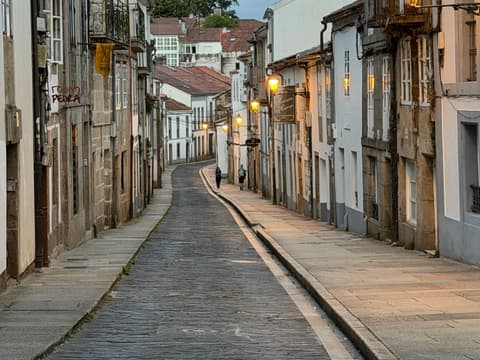
Beyond the cathedral, the old town is a UNESCO World Heritage Site of narrow granite streets, arcaded plazas, and the near-constant soft Galician rain. The Praza da Quintana, the Praza das Praterias, and the Parque da Alameda are all worth exploring. The Pilgrim Office on Rua das Carretas is where you collect your Compostela certificate. Pre-register online a day or two before arriving to reduce waiting times. The pilgrim mass at noon includes a reading of the nationalities and starting points of pilgrims who arrived the previous day. Hearing your own starting town called out, after weeks or months of walking, is a surprisingly emotional moment.
Santiago is also a vibrant university city with outstanding food. The Mercado de Abastos sells fresh seafood cooked at adjacent market stalls. The streets around Rua do Franco serve pulpo, percebes, empanada, pimientos de Padron, and Albarino white wine from the Rias Baixas coast. You have earned every bite.
However you got here, by whatever route, the Praza do Obradoiro is waiting. Sit on the stone ground, look up at the facade, and let it settle. There is no rush. The cathedral has been here for a thousand years. Stay as long as you need.
Explore Santiago de Compostela
Accommodation in Santiago de Compostela
Where You Are on the Camino
You are here
Santiago de Compostela
Part of