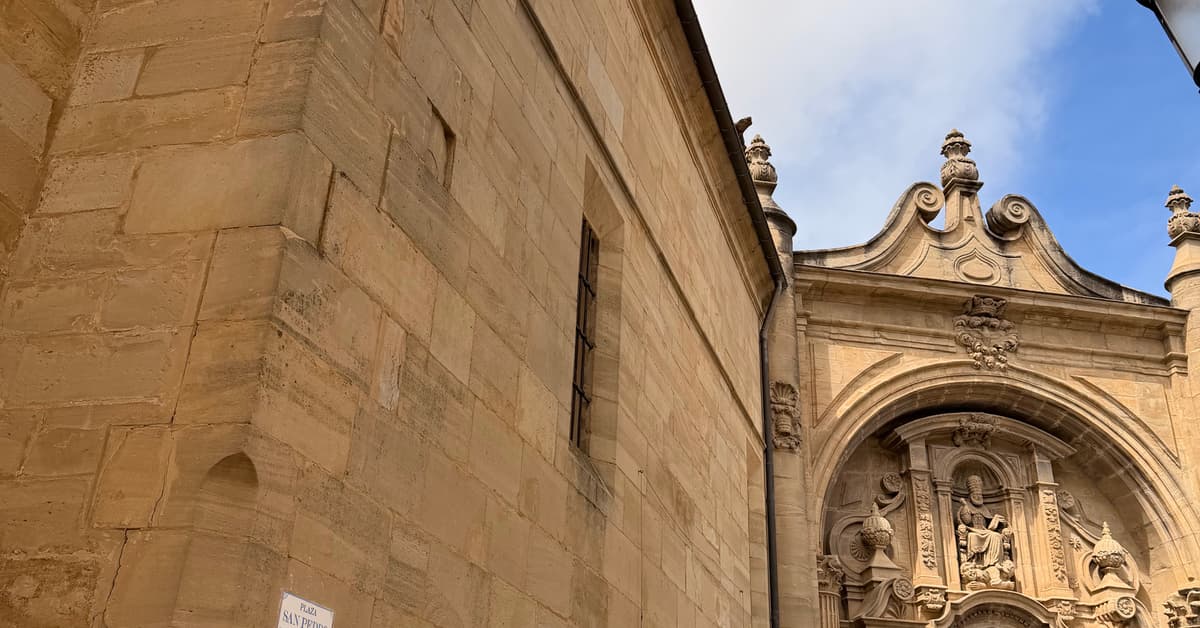
A historic walled town on the border of Navarra and La Rioja with a grand church, panoramic views, and the tomb of Cesare Borgia. A popular lunch stop between Los Arcos and Logrono.
Viana sits on a ridge above the Ebro plain, its silhouette dominated by the ruined nave of Santa María church and the remnants of medieval walls that once made it one of the most strategically significant towns in northern Spain. Pilgrims walking the Camino Francés pass through on the long stage between Los Arcos and Logroño, and Viana makes a natural halfway stop, roughly 10 kilometres from each.
The town's origins trace to 1219, when King Sancho VII of Navarra founded it as a fortified settlement to defend the kingdom's southern frontier against Castile. The name Viana is believed to derive from the Latin "via," a reference to the Roman road that ran through the area long before the medieval town existed. From its founding, Viana was designed not just as a town but as a strategic instrument of royal power, positioned on high ground overlooking the approaches from Castile and La Rioja. Its walls were formidable and its population was granted fueros, or special charters of rights, to attract settlers willing to live on a contested frontier.
The title Prince of Viana, given to the heir apparent of the Kingdom of Navarra, elevated the town's symbolic importance considerably. The most famous bearer of that title was Carlos de Viana, the tragic 15th-century prince whose conflict with his stepmother Queen Juana and his father Juan II of Aragon became one of the defining political dramas of late medieval Iberia. Carlos, a scholar and humanist admired across Europe, died in 1461 under circumstances that led many to suspect poisoning, and his death triggered widespread grief and political unrest across the Crown of Aragon.
The most striking historical figure associated with Viana, however, is Cesare Borgia, whose tomb lies inside the church of Santa María. Borgia, son of Pope Alexander VI and one of the most feared political operators of Renaissance Italy, fled to Navarra after his imprisonment and collapse of power in Rome. He served as a military commander for his brother-in-law, King Jean d'Albret of Navarra, and was killed in an ambush outside Viana in March 1507, aged around 31. He was initially buried with considerable ceremony inside the church, though his remains were later exhumed and reburied outside the church walls, reportedly because some felt the interior was too sacred a space for a man of his reputation. He was reinterred outside the church entrance, where a floor stone now marks the spot. The tomb has attracted visitors for centuries and remains one of the more unusual historical footnotes a pilgrim encounters on the Camino.
The church of Santa María itself is worth a close look. Construction began in the 14th century and continued in stages through the 16th century, blending Gothic and Renaissance elements. The west portal is richly decorated with carved figures and relief work, and the interior retains altarpieces and sculptures of considerable quality. Parts of the nave and roof have collapsed or been lost, giving the building a partially ruined grandeur that adds to rather than detracts from its atmosphere.
Approaching Viana from the west, the outskirts can feel underwhelming, with modern buildings that give little hint of what lies ahead. The town rewards those who push uphill into the old quarter, where the narrow streets, stone buildings, and the Plaza de los Fueros come together into something genuinely worth lingering in. The views from the town walls over the surrounding plains toward La Rioja are expansive. For pilgrims with gear needs, there is a well-stocked outdoor and sports shop in town carrying backpacks, footwear, and walking essentials. Cafes, restaurants, a supermarket, and basic services make Viana a practical stop as well as a historically rich one. Those who stay the night typically find it a more rewarding place than a brief midday break allows them to appreciate.
Every kind of bed in one place: online booking, direct-contact albergues, walk-ins and donativos. Live prices for your night.
The Camino through town, with prices where the beds are. Amber is the route; each pin is a place to stay.
Our Koala Picks first, then donativos, albergues and hostels, hotels, and everything else. Within each group the best-reviewed places lead.
Loading places to stay…
